
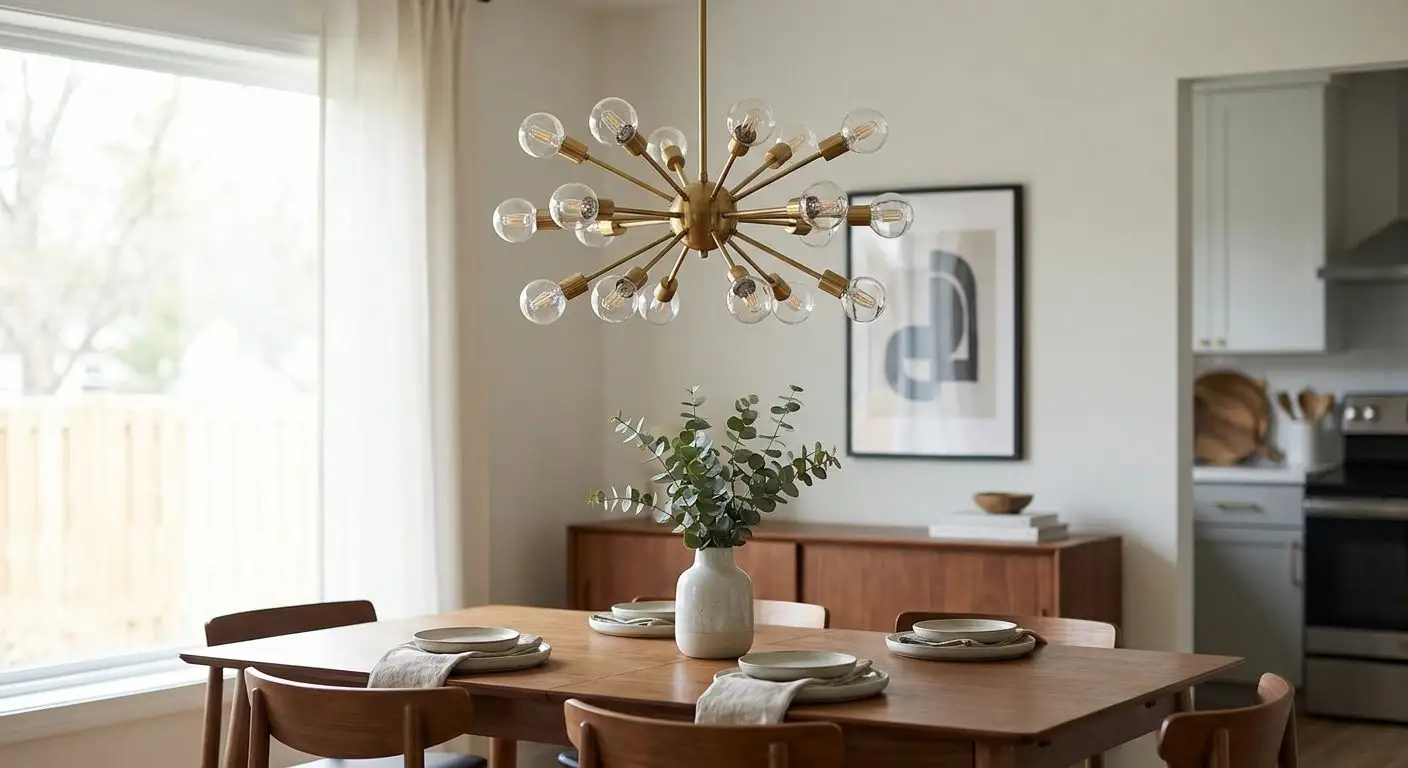
The first time I hung a Sputnik chandelier in my 1958 ranch, I was convinced the hard part would be the wiring. Turns out the real make or break moment was sizing. Too small and a Sputnik looks like it is floating awkwardly in space. Too big and it feels like a sea urchin is invading dinner.
The good news: you do not need a designer to get this right. With a tape measure, a little math, and one honest look at how you actually use your dining table, you can land on a diameter that fits and a drop height that feels intentional. And if you get close but not perfect, the tape test at the end will save you.
Before you measure
“Sputnik” gets used for a lot of mid-century inspired ceiling lights, but sizing and hanging depends on the shape.
- True radial Sputnik: Arms shoot out evenly in all directions, often with exposed bulbs or small globes.
- Globe Sputnik: Similar starburst, but the globes add visual mass. These usually read larger than their listed diameter.
- Linear or asymmetrical starburst: Still very mid-century, but you must consider length and direction, not just diameter.
For the rest of this guide, I use diameter language because it works best for the classic radial Sputnik. If your fixture is linear, use these same clearance ideas, but evaluate the overall length relative to the table.
Measure the dining zone
If your dining room is enclosed, the room is the zone. If you are in an open concept space, measure the dining “island” created by your table and the walk paths around it.
What to measure
- Room or dining zone length and width (in feet for the room formula)
- Table length and width (in inches, including leaves if you use them often)
- Ceiling height (in inches)
- Table height (most are 28 to 30 inches)
Quick note on listings: When you shop, use the fixture’s maximum overall diameter, meaning the widest point including arms, bulbs, and globes. Some product specs list a body size that does not include the “spikiest” parts.
If you are styling the rest of the space in a mid-century way, you will probably enjoy the lighting ideas over on Furniture & Lighting too.
Pick the right diameter
I like to run two quick checks, then choose the size that satisfies both. Sputniks have a lot of visual energy, so being “a little off” shows more than it does with a drum shade.
Method 1: Room formula
Add the room or dining zone length and width in feet. That total is your starting point for chandelier diameter in inches. I treat it as a range, not an exact number.
- Diameter (inches) = length (ft) + width (ft) (then consider going about 2 to 4 inches up or down)
Example: A 12 ft by 14 ft dining room: 12 + 14 = 26 inches. For a Sputnik, I would typically shop around 22 to 30 inches, then confirm with the table check below.
Method 2: Table rule
Most dining chandeliers look best when they are smaller than the tabletop, with comfortable breathing room at the edges.
- Choose a diameter that is about 1/2 to 2/3 the table width (for a round table, use the table diameter).
- Or keep at least 6 to 12 inches of clearance from the chandelier’s outermost point to the table edge on all sides.
Example: A rectangular table that is 38 inches wide: 38 x 0.5 = 19 inches, and 38 x 0.66 = 25 inches. A 20 to 24 inch Sputnik often feels right, depending on how far the arms and bulbs extend.
Reality checks for arms and globes
- Long, thin arms: You can go slightly larger without it feeling heavy.
- Big globes or thick arms: Consider sizing down because the fixture reads larger than its measurement.
- Exposed bulbs: Think about how close those bulbs will be to faces when seated. Comfort matters as much as style.
| Table type | Common table size | Often-right Sputnik diameter range |
|---|---|---|
| Round | 42 in | 20 to 28 in |
| Round | 48 in | 24 to 32 in |
| Rectangle | 36 to 40 in wide | 18 to 26 in |
| Rectangle | 42 to 44 in wide | 22 to 30 in |
These are not rules of the universe, just ranges that tend to look balanced in real homes with typical 8 to 9 ft ceilings and average fixture scale. When in doubt, I prefer slightly larger for Sputniks, as long as you still have comfortable table edge clearance.
Set the drop height
Sputniks look best when they feel centered in the room, but also visually tied to the table. The goal is a comfortable clearance from the tabletop so nobody squints through glowing bulbs while passing potatoes.
Standard clearance
- Bottom of chandelier to tabletop: 30 to 36 inches (starting range)
I use 32 to 34 inches as my sweet spot in most dining rooms with 8 ft ceilings. If you have tall family members, tall chairs, a fixture with exposed bulbs at the lowest point, or a walkway close by, nudge closer to 36 inches.
Adjust for ceiling height
A common guideline is to add about 2 to 3 inches of hanging height for each additional foot of ceiling height above 8 ft. Fixture scale matters, so treat this as a starting point, then tape test.
- 8 ft ceiling: 30 to 34 inches above the table
- 9 ft ceiling: 32 to 37 inches above the table
- 10 ft ceiling: 35 to 40 inches above the table
Estimate chain or rod length
If you want to get very practical, here is the simple way to estimate your downrod or chain length. Use inches for everything.
- Downrod length ≈ ceiling height (in) - table height (in) - desired clearance (in) - fixture height (in)
Example: 96 inch ceiling, 30 inch table, 34 inch clearance, and a 12 inch tall Sputnik body:
- 96 - 30 - 34 - 12 = 20 inches of rod or chain (approximately)
Manufacturers measure fixture height differently, so treat this as a planning number. I still do a tape test before committing.
Center it correctly
In an ideal world, the chandelier is centered on the table. In the real world, ceiling junction boxes love to land wherever they please.
Best case
- Center over the table, not the room, especially in open concept spaces.
If the box is off
- Swag it: Use a ceiling hook and swag kit rated for the fixture to shift it over the table. Confirm your ceiling box is fixture-rated and installed correctly. If you are unsure, hire a licensed electrician and follow local code.
- Move the box: More work, but the cleanest look if you are renovating anyway.
- Visually re-center: In some rooms, shifting the table slightly or adjusting a rug can make the alignment feel purposeful.
If you are working within an open concept layout, zoning makes a huge difference. I walk through a few helpful tricks here: House Tour: Zoning an Open-Concept MCM Living and Dining Room.
Do the tape test
Before you install anything, mimic the chandelier in the space. It takes five minutes and saves a lot of patching later.
- Mark the table center with a small piece of painter’s tape.
- Measure your target drop and mark that point on a nearby wall with painter’s tape.
- Hold a yardstick, a broom handle, or a piece of cardboard cut to the chandelier’s radius at the drop point to “see” the diameter.
- Sit down in your dining chair and check sightlines across the table.
If the fixture will have exposed bulbs, always do this test at seated eye level. It is the quickest way to catch a chandelier that looks fine standing up but feels blinding once you are actually eating.
Make it feel intentional
Keep it level
Sputnik arms amplify even a slight tilt. Use a small level during install, then step back and view it from multiple angles.
Choose bulbs on purpose
- Warm color temperature: 2700K is my go-to for walnut and vintage tones.
- Start with lower lumens: For multi-bulb Sputniks, I often start around 300 to 500 lumens per bulb, then rely on a dimmer for mood. If your fixture uses lots of bulbs, you do not need each one to be a spotlight.
- Dimmer friendly: A dimmer is practically part of the mid-century vibe. Make sure the bulbs and switch are compatible.
- Glare control: If you are using exposed bulbs, try lower output bulbs plus a dimmer rather than high output bulbs you never run at full power.
Watch nearby walk paths
If your dining area overlaps a main circulation route, err on the side of a slightly smaller diameter and a slightly higher hang. Those arms can stick out farther than your brain expects, especially at shoulder and head level when someone stands up from the table.
Mind the visual weight
If you hang a bold Sputnik, let it be the star. I like to keep nearby wall art a bit calmer, or echo the metal finish subtly in hardware or decor. If you are mixing metals across the room, this guide helps keep it cohesive: Mixing Brass, Copper, and Chrome in Mid-Century Modern Style.
Special cases
Low ceilings
- Look for a semi-flush Sputnik or a compact globe Sputnik.
- In low rooms, sizing down and keeping it tight to the ceiling is usually the safer lever than lowering it too far.
- If you do lower it, stay within comfortable sightlines and stick close to the 30 to 36 inches above the table clearance range.
High ceilings
- Consider a slightly larger diameter so the chandelier does not disappear overhead.
- Use additional downrod length to keep the fixture visually connected to the table.
- If you have a vaulted ceiling, make sure the canopy is compatible with an angled mount.
Long rectangular tables
If your table is long, especially 72 inches and up, a single round Sputnik can look like it is trying to cover too much territory.
- Option 1: Choose an oversized Sputnik and hang it slightly higher so it does not crowd the table edges.
- Option 2: Use a linear starburst fixture sized to the table length.
- Option 3: Hang two smaller Sputniks spaced evenly.
Common mistakes
Centered on the room, not the table
Fix: Re-center over the table, even if that means swaging or moving the box.
Feels tiny and fussy
Fix: Go up 4 to 6 inches in diameter, or choose a model with longer arms and fewer, more confident points.
Everyone complains about glare
Fix: Lower lumen bulbs, warmer temperature, add a dimmer, or switch to globes to soften the light source.
Hangs too high
Fix: Add downrod length so the bottom of the fixture lands within that 30 to 36 inch clearance zone above the tabletop.
Quick cheat sheet
- Diameter starting point: room length + room width (in feet) = diameter (in inches), then adjust about 2 to 4 inches as needed
- Table check: chandelier diameter about 1/2 to 2/3 of table width, using the overall max diameter including arms and bulbs
- Drop height: bottom of chandelier 30 to 36 inches above tabletop
- High ceilings: add about 2 to 3 inches of drop per extra foot of ceiling height, then tape test
- Always: do the tape test at seated eye level
One last Clara tip
If you are torn between two sizes, think about the feeling you want when you walk into the room. Mid-century dining rooms are at their best when they are a little theatrical, the glow is warm, and the silhouette is bold. A well-sized Sputnik is basically functional sculpture. Get the measurements in the right neighborhood, then trust the tape test to confirm what your gut already knows.